14k Gold vs 18k Gold: Which Should You Choose?
A practical head-to-head comparison of 14k Gold and 18k Gold, covering quick verdict, key differences, category winners, buyer fit, and FAQ.
14k Gold vs 18k Gold: Which Should You Choose?
Head-to-head comparison
Overall winner: 14k Gold for its superior blend of durability, colour, and value for daily wear.
For most people, 14k gold offers the ideal balance, making it perfect for engagement rings and everyday jewellery that needs to withstand an active life. 18k gold is a fantastic choice for those prioritising purity and a richer, more saturated yellow hue, especially for special occasion pieces or for individuals with sensitive skin.
This comparison is based on detailed material science, current market pricing, and analysis of long-term owner feedback from across the UK. We've assessed both gold purities against the criteria that matter most for a lifetime of wear: durability, appearance, value, and practicality.
Choosing between 14k and 18k gold is one of the most common dilemmas when buying fine jewellery. On the surface, it seems simple: 18k has more pure gold, so it must be better. However, the reality is more nuanced. The "best" choice depends entirely on your lifestyle, budget, and priorities. Pure gold (24k) is extremely soft, so other metals (alloys) are mixed in to create durability. 18k gold contains 75% pure gold, while 14k contains 58.5%. This difference in composition creates a critical trade-off between the rich, warm glow of higher-purity gold and the resilience needed for a piece you’ll wear every day. This guide will walk you through that trade-off, ensuring you select the perfect gold for you.
Option A
14k Gold
- Best for everyday wear & engagement rings
- Excellent durability & scratch resistance
- More affordable price point
Option B
18k Gold
- Best for luxury pieces & sensitive skin
- Richer, more vibrant yellow colour
- Higher intrinsic value due to gold content
Head-to-Head Scorecard
Measurement
Durability & Routine Fit
When it comes to fine jewellery, especially pieces you intend to wear daily like an engagement ring or a favourite necklace, durability is paramount. This is where the distinction between 14k and 18k gold becomes most critical. Gold itself is a very soft, malleable metal. In its pure 24k form, it can be easily bent or scratched. To make it suitable for jewellery, it's mixed with stronger alloy metals such as copper, silver, zinc, and nickel.
14k gold is composed of 58.5% pure gold and 41.5% other metals. This higher percentage of alloys makes it significantly harder and more durable than 18k gold. It is more resistant to scratches, dents, and scuffs that inevitably occur with daily life—typing on a keyboard, carrying shopping bags, or accidentally knocking your hand against a surface. This resilience makes 14k gold the default recommendation for engagement and wedding rings, which are subject to constant exposure.
18k gold, being 75% pure gold and only 25% alloys, is noticeably softer. While it is certainly durable enough for jewellery, it requires more mindful wear. It is more prone to scratching and can show signs of wear more quickly than its 14k counterpart. For this reason, 18k gold is often preferred for pieces that are less exposed to impact, such as earrings, pendants, or rings reserved for special occasions rather than constant, active wear.
Measurement
Colour & Purity
The colour of gold jewellery is one of its most defining characteristics, and the karat number directly influences this. The higher the pure gold content, the more intense and saturated the yellow hue will be.
18k gold, with its 75% gold content, boasts a rich, deep, and warm yellow colour that is highly prized in fine jewellery. It has a luxurious lustre that is visibly more golden than 14k. This is the classic, buttery-yellow look that many people associate with high-end gold pieces from premier European jewellery houses.
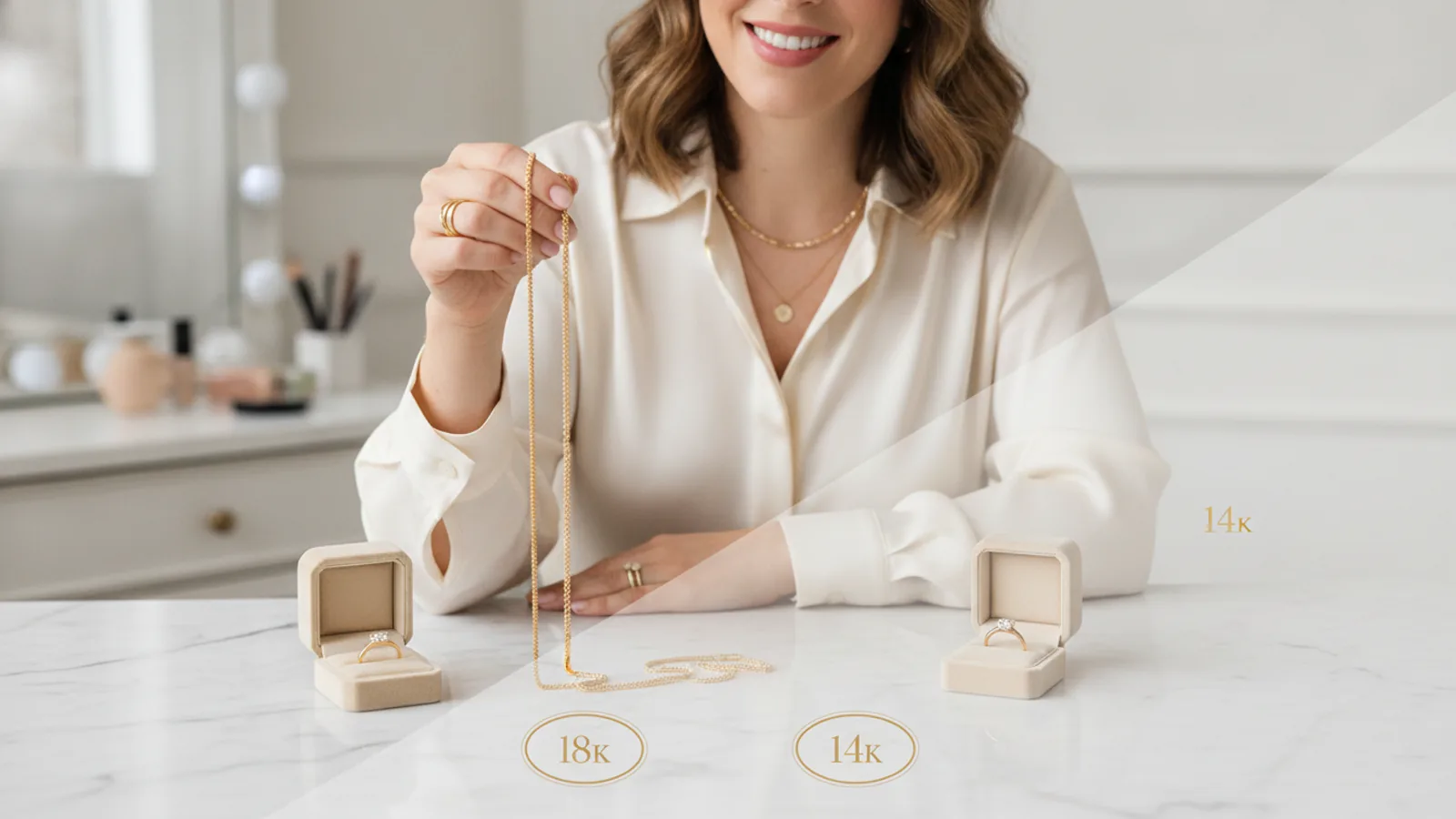
14k gold, containing 58.5% gold, has a lighter, paler yellow hue. The 41.5% alloy content subtly dilutes the intensity of the gold, resulting in a softer, more champagne-like yellow. This is by no means a drawback; many people actually prefer this gentler shade as it can be more flattering on cooler skin tones. The colour difference is noticeable when the two are placed side-by-side, but on its own, 14k gold is still beautifully and recognisably golden.
For rose gold and white gold, the difference is less about the intensity of the yellow and more about the overall tone. 18k rose gold will have a warmer, more golden-pink hue, while 14k rose gold can appear slightly pinker due to a higher copper content. For white gold, both are plated with rhodium for a bright white finish, making the underlying gold colour almost irrelevant. However, as the plating wears, an 18k white gold piece may reveal a faint yellowish tinge, whereas a 14k piece will have a less noticeable colour difference.
Measurement
Hypoallergenic Properties
For those with sensitive skin, the composition of gold jewellery is a crucial consideration. Allergic reactions to gold are rare; it's typically the alloy metals, particularly nickel, that cause contact dermatitis, leading to redness, itching, or rashes.
Because 18k gold is 75% pure, it contains only 25% alloy metals. This significantly lower percentage of potential irritants makes it a much safer choice for individuals with known metal allergies or sensitive skin. It is considered highly biocompatible and is less likely to cause a reaction.
14k gold contains a much larger proportion of alloys (41.5%). While many modern jewellers in the UK and Europe use nickel-free alloys (often substituting palladium or manganese), it's not a universal standard. If a 14k piece does contain nickel, the higher concentration increases the likelihood of a skin reaction for sensitive individuals. If you have sensitive skin but prefer 14k gold for its durability or price, it is essential to confirm with the jeweller that the alloy is nickel-free.
However, for guaranteed peace of mind and the lowest possible risk of irritation, the choice is clear. The purer the gold, the less there is of anything else to cause a problem.
Measurement
Price & Value
The price of a piece of gold jewellery is primarily determined by its gold content, or "gram weight," as well as the complexity of the design and the brand's markup. Since gold is priced by weight, it follows that a piece made from 18k gold will be more expensive than the exact same piece made from 14k gold, simply because it contains more pure gold.
18k gold contains 16.5% more pure gold than 14k gold (75% vs 58.5%). This difference typically translates to a price increase of 25-40% for 18k over 14k, depending on the item. For a simple wedding band, this might be a manageable difference. For a heavy chain or a large, intricate engagement ring setting, the cost can increase substantially, making 14k a much more accessible option.
From a "value" perspective, the argument can be made both ways. 18k gold has a higher intrinsic value due to its greater gold content, which means it will have a higher scrap or resale value. However, most people buy jewellery to wear, not as a financial investment. In this context, "value" means getting the best combination of beauty, longevity, and affordability. 14k gold excels here. It delivers the timeless look and feel of real gold and offers superior durability for a significantly lower initial outlay. For the majority of buyers, this makes it the better value proposition for their money.
Measurement
Maintenance & Long-Term Care
All fine jewellery requires some level of care to keep it looking its best, but the needs of 14k and 18k gold can differ slightly due to their hardness. The main aspect of long-term care is managing surface wear, such as scratches and loss of lustre, and ensuring structural integrity, particularly for settings with gemstones.
As we've established, 14k gold is the harder of the two. This means it is more resistant to fine scratches and minor abrasions. Over time, it will develop a patina of wear, but it tends to do so more slowly and less dramatically than 18k gold. It requires less frequent polishing to restore its original high-shine finish and is less likely to suffer from deep gouges or dents from accidental impacts. The prongs holding a gemstone in a 14k ring are also more rigid, offering slightly more security over many years of wear.
18k gold, being softer, will show scratches and scuffs more easily. A piece worn daily will require more regular professional polishing to maintain its mirror-like finish. While this softness also means it's easier for a jeweller to work with for repairs or resizing, it demands more caution from the wearer. It’s advisable to remove 18k gold rings when engaging in manual tasks, visiting the gym, or gardening to prevent damage. While the difference isn't night and day, 14k gold is simply more forgiving of an active, less-than-perfectly-careful lifestyle.
Choose 14k Gold If...
- You have an active lifestyle or work with your hands.
- The jewellery is for everyday wear, such as an engagement ring or wedding band.
- You are looking for the best balance of beauty, durability, and affordability.
- You prefer a slightly lighter, more subtle shade of yellow gold.
- You want a lower-maintenance piece that is more resistant to scratches and scuffs.
Choose 18k Gold If...
- You prioritise the rich, deep yellow colour and luxurious feel of higher-purity gold.
- You have sensitive skin or known allergies to metals like nickel.
- The piece is for special occasions rather than constant, rugged wear.
- Your budget is more flexible and you appreciate the higher intrinsic value.
- You are careful with your jewellery and don't mind the need for more frequent polishing.
Choose 14k Gold If
- You want the stronger default fit after checking the current evidence.
- You care about broader usefulness across the main comparison criteria.
- You prefer the option with clearer decision support for most readers.
Choose 18k Gold If
- Your situation matches 18k Gold's narrower strength more closely.
- You prefer a simpler starting point with fewer tradeoffs to manage.
- You have verified the current details and they fit your specific priority.
Final Verdict: 14k Gold vs 18k Gold
Both 14k and 18k are excellent choices for fine jewellery, and the "better" option is truly subjective. However, after comparing them across the key metrics of durability, appearance, price, and practicality, there is a clear winner for the majority of UK buyers.
The overall winner is 14k gold. It strikes an almost perfect balance between the preciousness of gold and the practical demands of modern life. Its superior durability and scratch resistance make it the ideal choice for pieces that are meant to be worn and loved every day, especially engagement rings. When you factor in its more accessible price point, it delivers outstanding value without a significant compromise on the beauty and lustre that makes gold so desirable.
That is not to diminish the appeal of 18k gold. For the connoisseur who desires that deep, buttery yellow hue, for those with sensitive skin who need the highest purity, or for a treasured piece that will be worn with care on special occasions, 18k gold remains the pinnacle of luxury. It is a beautiful, valuable metal that rightly holds its place at the top end of the market. But for a lifetime of wear, worry, and wonder, 14k gold is the more sensible, resilient, and practical champion.
14k Gold vs 18k Gold: Which Should You Choose? FAQ
Is 18k gold too soft for an engagement ring?
No, 18k gold is not "too soft" for an engagement ring, and it has been used for centuries. Millions of people wear 18k rings daily without issue. However, it requires more mindful wear than 14k gold. You should be prepared to remove it during activities like sports, cleaning, or heavy lifting to avoid scratches and potential warping over time. If you have a very active lifestyle or prefer a "wear it and forget it" approach, 14k gold is a safer choice.
Can you visually tell the difference between 14k and 18k gold?
Yes, especially in yellow gold. When placed side-by-side, 18k yellow gold has a noticeably richer, deeper, and more saturated yellow colour. 14k yellow gold appears slightly paler in comparison. For most people, the difference is subtle and may not be obvious from a distance, but to a discerning eye, the warmth of 18k is distinct. For white gold, there is no visual difference as both are plated with rhodium for a bright white finish.
Does 18k gold tarnish?
Pure gold does not tarnish or corrode. Because 18k gold is 75% pure, it is highly resistant to tarnishing. The small percentage of alloy metals (like silver or copper) can technically react with elements in the environment over a very long time, but this is extremely rare and minimal in high-karat gold. For all practical purposes, neither 14k nor 18k gold will tarnish in the way that sterling silver does.
How do I know if my jewellery is 14k or 18k?
Look for the hallmark, which is a small stamp usually located on the inside of a ring's band, on the clasp of a necklace, or on the post of an earring. In the UK, these hallmarks are legally required. 18k gold will be stamped with "750" (indicating 75% gold). 14k gold will be stamped with "585" (indicating 58.5% gold). You may also see the karat mark itself, such as "18k" or "14k".
Is white gold or yellow gold more durable in 14k vs 18k?
The durability is determined by the karat, not the colour. Therefore, 14k yellow gold and 14k white gold are similarly durable, and both are more durable than their 18k counterparts. However, white gold has an advantage: it is plated with rhodium, an extremely hard metal from the platinum family. This rhodium plating provides an extra layer of scratch resistance, making a 14k white gold ring arguably the most durable option for everyday wear. This plating does wear off over time and needs to be reapplied every 1-3 years.