18k vs 14k Gold: Which Should You Choose?
A practical head-to-head comparison of 18k and 14k Gold, covering quick verdict, key differences, category winners, buyer fit, and FAQ.
18k vs 14k Gold: Which Should You Choose?
Head-to-head comparison
Overall winner: 14k gold for its superior durability and excellent value.
For most people, particularly for engagement rings and jewellery intended for daily wear, 14k gold offers the ideal balance of beauty, strength, and affordability. While 18k gold boasts a higher purity and a richer colour, its softness makes it less practical for an active lifestyle, reserving it for special occasion pieces or for those who prioritise purity above all else.
Deciding between 18k and 14k gold is one of the most common dilemmas when investing in fine jewellery. This 2026 guide is based on a detailed analysis of the metallurgical properties, market pricing, and typical wearer feedback for both alloys to give you a clear, practical recommendation.
At a glance, the choice seems simple: 18k is purer gold, and 14k is more durable. However, the right choice for you depends entirely on the piece of jewellery in question, your lifestyle, skin sensitivity, and budget. One is not universally 'better' than the other; they simply serve different purposes. Let's break down the key differences to find your perfect match.
The Luxury Choice
18k Gold
- Best for: Investment pieces & sensitive skin
- Strength: Rich, deep yellow colour
- Tradeoff: Softer and more prone to scratching
The Practical Choice
14k Gold
- Best for: Daily wear & engagement rings
- Strength: Highly durable & great value
- Tradeoff: Slightly paler colour than 18k
Head-to-Head Scorecard
Measurement
Purity & Colour
The "k" in 18k and 14k stands for karat, a measure of gold purity out of 24 parts. Pure gold is 24k, meaning all 24 parts are gold. It's incredibly soft and a very intense yellow-orange, making it unsuitable for most jewellery.
18k gold is 18 parts gold and 6 parts other metals (75% gold). This high gold content gives it a noticeably richer, warmer, and more saturated yellow colour. It has a luxurious, deep glow that is unmistakably high-quality. If the truest, most vibrant gold colour is your priority, 18k is the undisputed champion.
14k gold is 14 parts gold and 10 parts other metals (58.3% gold). The higher proportion of alloys like copper, silver, and zinc slightly dilutes the yellow colour. The result is a beautiful, warm gold, but it is subtly lighter and less intense than its 18k counterpart. For many, this softer hue is just as desirable and complements a wider range of skin tones.
Measurement
Durability & Hardness
While purity sounds like the most important factor, durability is arguably more critical for the longevity of your jewellery, especially for items worn frequently. This is where the trade-off between the two karats becomes most apparent.
18k gold, being 75% pure gold, retains much of gold's natural softness. It is more susceptible to scratching, scuffing, and bending than 14k gold. This makes it a less-than-ideal choice for pieces that will experience a lot of contact, such as engagement rings for someone with a very active job or bracelets that might knock against desks and doors. It's perfectly suitable for pendants, earrings, or rings worn with care on special occasions.
14k gold benefits greatly from its larger proportion of alloy metals. These metals (like copper and zinc) are much harder than pure gold, lending their strength to the final product. This makes 14k gold significantly more durable and resistant to the wear and tear of daily life. It's the industry standard for engagement rings in the UK and US for this very reason—it’s designed to last a lifetime while being worn every day.
Measurement
Value for Money
The price of gold jewellery is primarily determined by its gold content. As gold is a precious and expensive commodity, the more of it in an item, the higher the price will be. This creates a significant price difference between 18k and 14k gold pieces, even if they are identical in design and weight.
18k gold contains more pure gold (75% vs. 58.3%), so it is always the more expensive option. For a simple wedding band or a pair of earrings, the price difference might be manageable. However, for a larger, heavier piece like an engagement ring with a substantial band or a statement necklace, the cost can increase by 25-40% or more, just for the metal choice alone. This premium pays for the purity and colour, but not for durability.
14k gold provides the look and feel of high-quality gold at a much more accessible price point. Because it uses less of the most expensive raw material (gold), you can often afford a more substantial design or allocate more of your budget towards the gemstone. For most buyers, 14k gold represents the sweet spot of affordability, appearance, and longevity, making it an excellent value proposition.
Measurement
Hypoallergenic Properties
For those with sensitive skin, the metals mixed with gold can sometimes cause irritation or an allergic reaction. The most common culprit is nickel, which is often used as an alloy. The higher the gold content, the lower the percentage of these potentially irritating alloys.
18k gold is composed of only 25% alloy metals. This significantly reduces the likelihood of it containing enough nickel or other irritants to cause a reaction. For this reason, 18k gold is often recommended as the more hypoallergenic choice and is a safer bet for anyone with a known metal sensitivity. It’s the closest you can get to pure gold while still having enough strength for jewellery.
14k gold contains 41.7% alloy metals, increasing the potential for a higher concentration of nickel. While many people wear 14k gold their entire lives with no issues, those who are highly sensitive may find it causes redness or itching. It's important to note that many modern jewellers now use nickel-free alloys (often palladium-based for white gold) to make their 14k gold more widely wearable, but it's not a guarantee unless specified.
Measurement
Routine Fit & Lifestyle
The best gold for you is the one that fits seamlessly into your daily life. This decision comes down to a simple assessment of your daily activities and how you plan to wear the piece.
18k gold is best suited for a more careful wearer or for pieces that are inherently protected from impact. Think earrings, necklaces, brooches, or fine dress rings that are brought out for dinners and events rather than worn while gardening or at the gym. If you work in a low-impact environment (e.g., an office job) and are mindful of your jewellery, an 18k engagement ring can be a beautiful choice, but it will require more vigilance to keep it pristine.
14k gold is the workhorse of the fine jewellery world. It's the perfect choice for anyone with an active lifestyle or for pieces that are designed to be worn constantly, such as wedding bands and engagement rings. It can withstand more knocks, scrapes, and bumps without showing as much wear. If you want a piece you can put on and largely forget about, without constantly worrying about damaging it, 14k gold is the clear and sensible option.
Choose 18k Gold If...
- Purity is your priority: You value having jewellery that is 75% pure gold.
- You have sensitive skin: You have known metal allergies and need the most hypoallergenic option available.
- You desire the richest colour: The deep, saturated yellow of 18k gold is the exact look you want.
- The piece is for special occasions: It's a dress ring, pendant, or earrings that won't be subject to heavy daily wear.
- Budget is a secondary concern: You are comfortable with the higher price point for the added luxury and purity.
Choose 14k Gold If...
- The jewellery is for daily wear: It's an engagement ring, wedding band, or bracelet you plan to wear constantly.
- You have an active lifestyle: You work with your hands, exercise frequently, or are generally less gentle with your jewellery.
- Value is important: You want the best balance of quality, beauty, and price, allowing you to invest more in design or stone size.
- You prefer a slightly softer colour: You find the brighter, lighter hue of 14k gold more complementary to your skin tone.
- You are buying a gift for someone whose lifestyle you are unsure of: 14k gold is the safest, most durable bet.
Choose 18k If
- You want the stronger default fit after checking the current evidence.
- You care about broader usefulness across the main comparison criteria.
- You prefer the option with clearer decision support for most readers.
Choose 14k Gold If
- Your situation matches 14k Gold's narrower strength more closely.
- You prefer a simpler starting point with fewer tradeoffs to manage.
- You have verified the current details and they fit your specific priority.
Final Verdict: 18k vs 14k Gold
After a thorough comparison, 14k gold emerges as the overall winner for most UK buyers in 2026. Its exceptional blend of durability, beauty, and value makes it the most practical and logical choice for the most significant jewellery purchases, especially engagement rings and wedding bands. It provides the timeless appeal of gold in a format that is built to withstand the realities of a modern, active life, all at a more accessible price.
This does not diminish the allure of 18k gold. It remains the connoisseur's choice, the ultimate selection for those who prioritise the intrinsic value and rich, warm colour of purer gold above all else. For a special pair of earrings, a treasured pendant, or for anyone with pronounced metal sensitivities, 18k gold is an exquisite and worthy investment. The key is to match its delicate nature with the right purpose.
Ultimately, your choice is personal. For a lifetime of daily wear, choose 14k. For moments of pure luxury, choose 18k.
18k vs 14k Gold: Which Should You Choose? FAQ
Is 18k gold better than 14k?
18k gold is 'better' in terms of purity and colour, as it contains more pure gold (75%). However, 14k gold is 'better' in terms of durability and value, as it's harder and less expensive. The "better" choice depends on your priorities: luxury and colour (18k) versus practicality and strength (14k).
Can you visually tell the difference between 14k and 18k gold?
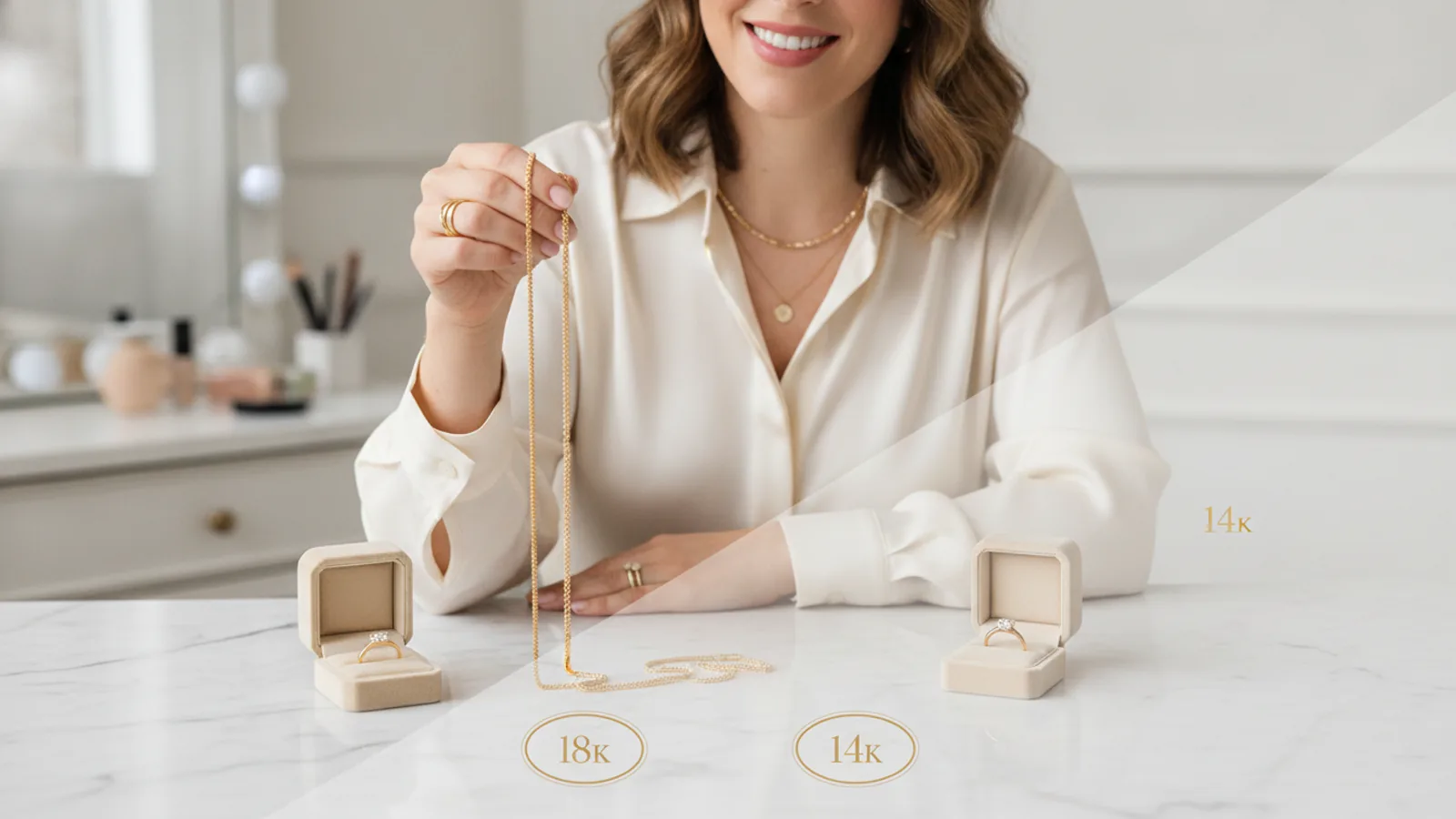
Yes, but the difference is subtle. When placed side-by-side, 18k gold has a richer, deeper, and more saturated yellow hue. 14k gold is slightly lighter and brighter. Most people would not be able to identify the karat just by looking at a single piece in isolation.
Which is better for an engagement ring, 14k or 18k gold?
For most people, 14k gold is the better choice for an engagement ring. Since an engagement ring is worn daily and subject to a lot of potential impact, the superior durability of 14k gold makes it more resistant to scratches and bending, ensuring the setting remains secure for decades.
Does 14k or 18k gold tarnish?
Neither 14k nor 18k gold will tarnish, rust, or corrode. Gold is a very non-reactive metal. The alloy metals mixed with the gold are also typically non-reactive (like silver, copper, palladium). Any dullness that appears over time is usually due to a build-up of oils and lotions, which can be cleaned off easily.
Is 18k gold worth the extra money?
Whether 18k gold is worth the extra money is a personal decision. If you have very sensitive skin, prioritise the richest gold colour, or are buying a piece that will be worn carefully and infrequently, the premium for 18k can be a worthwhile investment in luxury. For everyday pieces, the extra cost doesn't translate to better longevity—in fact, it's the opposite.